Kyoto Landmarks and Monuments
(Kyoto, Kansai, Central Honshu, Japan)
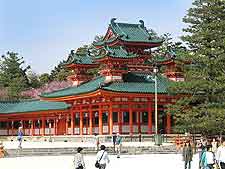
Once the imperial capital of the country, it comes as no surprise that Kyoto has a wealth of historical landmarks and monuments, namely its dozens of ancient shrines and temples. A visit to this cultural centre will enlighten you on centuries-old traditions, religious architecture, traditional costume and Japanese gardens and arts.
The city of Kyoto houses extensive culturally-important collections within the walls of some of its most significant villas. Kyoto's main landmarks and monuments are detailed below.
Heian Shrine
Address: Okazaki Nishitenno-cho, Kyoto, 26 606 8341, Japan, JP
Tel: +81 075 761 0221
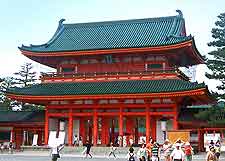
This orange structure is one of the most imposing shrines in Kyoto, constructed in 1884 to celebrate the city's 1,100th birthday and honour the first and last emperors that reside here. Based on the Heian Period Imperial Palace, the shrine is a smaller version. The landscaped gardens surrounding the Heian Shrine are stunning to say the least and boast a large pond, plentiful flowers, a covered bridge and in the spring, abundant cherry blossom.
Open hours: daily - 08:30 to 16:00
Admission: charge
Kinkakuji (Golden Pavilion)
Address: 1 Kinkakuji-cho, Kyoto, 26 603 8361, Japan, JP
Tel: +81 075 461 0013
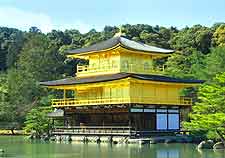
Better known by foreigners as the Golden Pavilion, this unique gold-painted structure and its garden are amongst the most heavily photographed landmark in Kyoto. The three-storey pavilion has roofs that gently curve upwards at the edges, while the second and third storeys are gold-leaf coated. The pond, which lies adjacent to the Kinkakuji, provides a clear reflection of the building when weather permits. Although a villa was constructed here in 1397 by shogun Ashikaga Yoshimitsu, it was burnt down by a young monk, inspiring the book that followed, Kinkakuji. The current building was constructed in 1955 and is an authentic copy of the original.
Open hours: daily - 09:00 to 17:00
Admission: charge
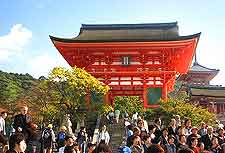
Kiyomizudera Temple
Address: 1-294 Kiyomizudera, Kyoto, 26 605 0862, Japan, JP
Tel: +81 075 551 1234
Also known as the Temple of Pure Water, Kiyomizudera is a beautiful temple situated on a hillside. Built in 798 AD, it is thought by the Japanese that a visit to the Shinto shrine inside the temple can bring you success in finding a suitable partner, and is therefore popular amongst young Japanese. This prominent landmark consists of a main hall set on an extensive wooden terrace and is surrounded by the temple grounds and a pagoda. The views from the terrace are yet another reason to visit.
Open hours: daily - 06:00 to 18:00
Admission: charge
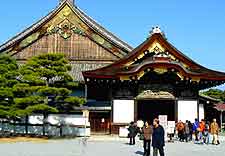
Nijo Castle
Address: Nishi Nijojo Nijohorikawa, Kyoto, 26 604 8235, Japan, JP
One of Kyoto's most visited historic landmarks, Nijo castle was formerly the power base of shogun Tokugawa Ieyasu in the early 1600s. Unlike the austere buildings of the imperial family, the castle displays its wealth and power in a rather ostentatious fashion. Damaged by a fire in 1788, Nijo Castle was soon rebuilt to exude its former military might. Students from the Kano School were used to paint ferocious animals within the interior, such as tigers and leopards, to symbolize strength. However, Tokugawa was not without fear, and installed squeaky wooden floors that would act as a warning against night intruders.
Open hours: daily - 08:45 to 17:00
Admission: charge


 - Google+